
Camden, NJ; September 30, 2026: Today, Holtec’s Corporate Engineering business unit submitted the Preliminary Safety Analysis Report (PSAR) to the US Nuclear Regulatory Commission (NRC) completing the second phase of the Construction Permit Application (CPA) process initiated with the Limited Work Authorization (LWA) application and Environmental Report (ER) submitted in December of 2025. The PSAR provides the NRC with detailed technical and safety information supporting Holtec’s application to construct Pioneer 1 & 2, two planned SMR-300 small modular reactors at the Palisades site in Covert Township, Michigan. Together, the units are designed to provide an additional 680 megawatts of generating capacity. This submittal, the most significant step to date toward establishing the regulatory framework for the Pioneer plant, was preceded by numerous pre-submittal engagement meetings with the NRC and sustained rigorous technical interactions with the Commission’s staff.
Judging by the renewed intensity of the regulatory review and associated technical interactions with the NRC, the Latin phrase, Grandis Ferocious [gradual and methodical at first, then ferociously], aptly captures the activity of our multinational development team across the United States, United Kingdom, Spain, Ukraine, and India (under Part 810 authorization) as it advances the technical foundation for the (most likely) industry’s first SMR-300 plant.
Some recent milestones that speak to the accelerating technical and regulatory momentum in the SMR program:
- A novel civil construction method using shop-fabricated modules, validated through extensive testing at Purdue University, could significantly reduce labor requirements compared with conventional construction methods. The associated Licensing Topical Report (LTR) was audited and accepted by the NRC in September 2026, with the Safety Evaluation Report (SER) expected by early November 2026. The method will revolutionize plant construction and provide significant financial benefits to the project.
- An LTR defining an innovative methodology to more accurately prognosticate soil-structure interaction (SSI) effects under different seismic and soil conditions was audited and accepted by the NRC in September 2026, with the SER anticipated by the end of October 2026. The methodology will support deployment of a standard SMR-300 design across a broad range of sites worldwide.
- An LTR describing an innovative instrumentation and control architecture was audited and accepted by the NRC in August 2026, with official regulatory approval anticipated in October 2026.
- The NRC’s draft SER for the LWA application, the first phase of the CPA, is anticipated in December 2026. The NRC audit was closed in September 2026.
The twin-unit Pioneer plant will become part of the Palisades Energy Campus, anchored by the 805 MWe Palisades plant in Michigan, which is in the final stages before repowering.
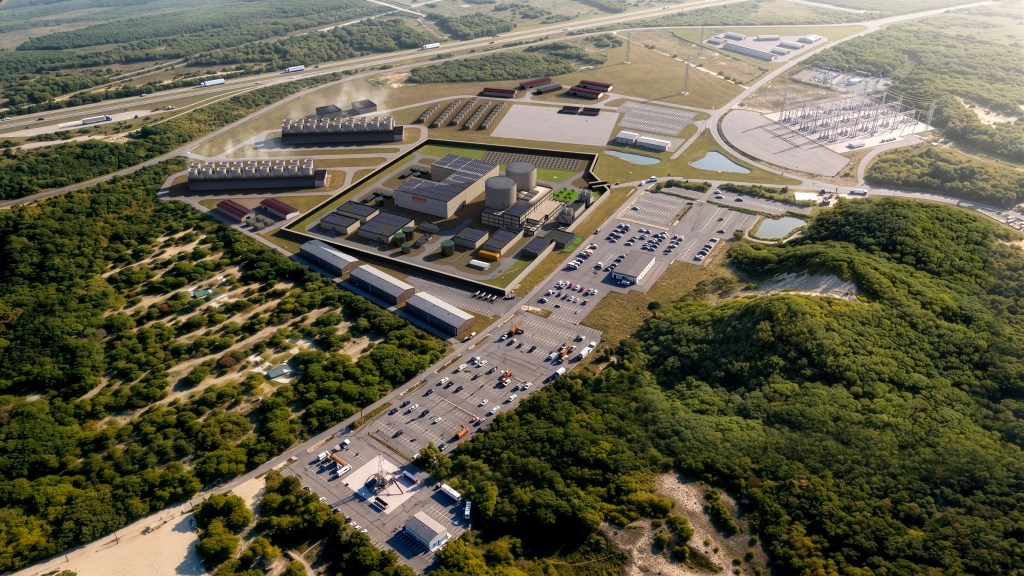
Since its launch in March 2011, Holtec’s SMR program has advanced through sustained research and development, design refinement, testing, and regulatory engagement in pursuit of a safe, efficient, and broadly deployable small modular reactor. This sustained effort is now reaching a crescendo as the Pioneer team strives to embed the plant’s design with the last set of innovative features that further reinforce SMR-300’s inherent safety and further improve compactness of the required land area, facilitate on-site indefinite duration subterranean storage of its used fuel, and eliminate the need for an “exclusion zone” around the plant that exemplifies SMR-300’s peerless radiation containment attributes.
Next items on the development agenda are completion of a Class 2 construction estimate, a 4D simulation of the entire plant showing the step-by-step evolution of construction, and completion of the confirmatory safety analyses supporting the plant’s Final Safety Analysis Report (FSAR).
We are grateful for the U.S. Department of Energy’s generous and timely support of the Pioneer deployment program, which is helping accelerate the project. We also appreciate the NRC’s risk-informed regulatory posture, critically constructive engagement, and responsiveness of their staff, which have helped enable the strong pace of progress reported herein. And we remain in debt to our global SMR-300 team for their hard work, dedication, and commitment to our shared goal to provide clean baseload electrical energy to people in the US and around the world.
You must be logged in to post a comment.